(中文翻译在英文正文之后)
The Yangtze River is almost twenty kilometers wide here. We’re sailing in the estuary. After just one or two kilometers, with the skyline of Shanghai’s business district still in sight, we’re digitally cut off from the outside world, beyond the reach of cell towers. Buying a cup of disgusting instant coffee – just 10 CNY – grants us access to the upper deck, with a better view. Many fellow passengers wear face masks in the closed, stuffy space. Today, my air quality app shows level 152 within the inner ring road, or code red. But on Chongming Island, where we’re headed, it’s level 29, or green. Upon arrival, the air we breathe feels considerably better. A five-minute walk from the mooring, we encounter a first incursion of urban comfort into the until recently predominantly rural island: Starbucks and KFC. We quickly take the bus to Yongle Cun, one of the first model villages for rural revitalization on this island, annexed by Shanghai in 1958, most of which consist of reclaimed polder from Mao’s time.
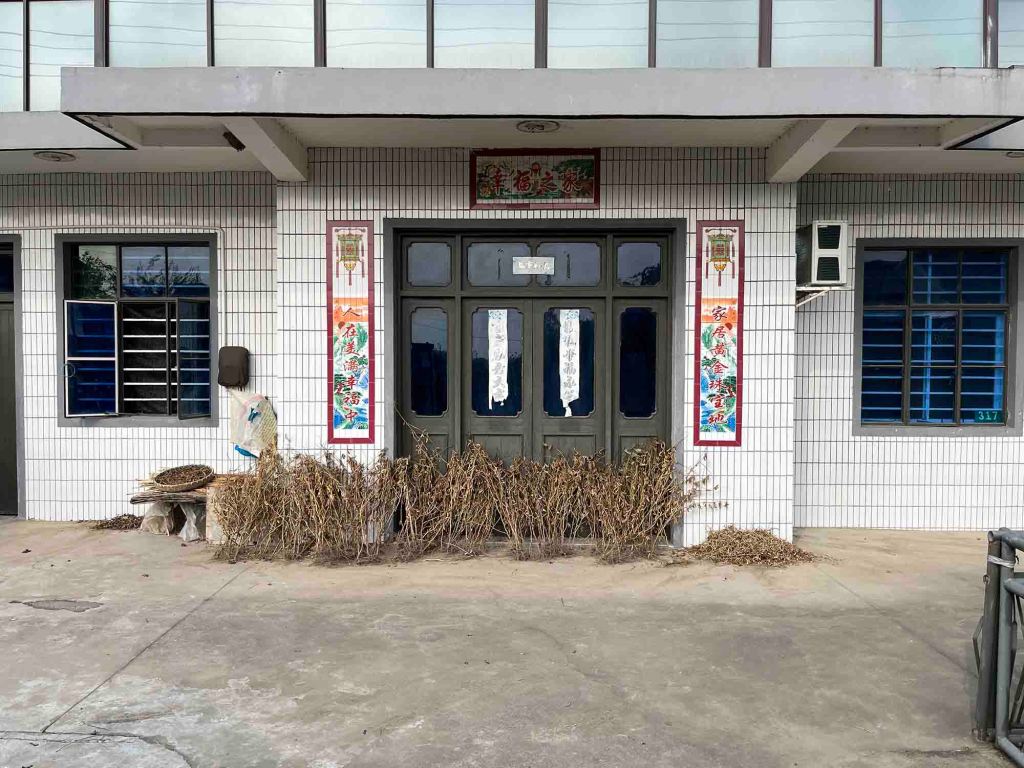
Despite high agricultural productivity, Yongle Cun wasn’t very prosperous until recently. Since 2021, the village has been promoting the cultivation of herbs for Traditional Chinese Medicine. Meanwhile the village collective focuses on leisure activities for the elderly. In the spring, there are flower shows and other activities to attract a wider range of visitors. Many city dwellers come here to take photos of the purple saffron blossoms. According to state media, it’s a lively place. But, as expected, this is limited to the few national holidays and harvest festivals.
During our walk, we speak to several villagers. Many residents here belong to a minority group and speak a dialect unintelligible to non-islanders. Along the road, we see some elderly playing majong. There’s not much else to do. Young people have long since left. Farm work is done by seasonal workers. There are a dozen homestays in empty farmhouses.
On the way back, it’s pitch dark, there are no streetlights. We smell the characteristic aroma of burnt coals and wood; the fires are still going strong in the excellent traditional rural kitchens here.
 乡村足迹 Rural Footprints